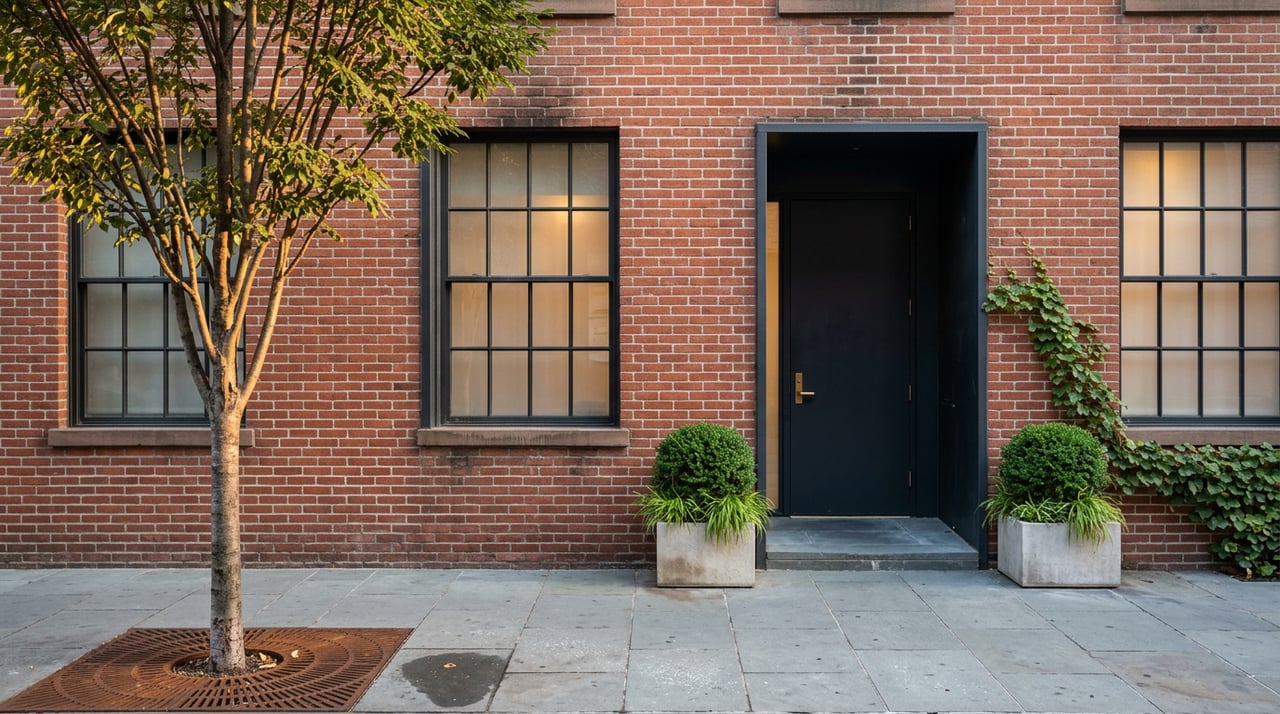
For twenty-eight years, if you wanted a jam-and-toast breakfast inside Chelsea Market, you went to Sarabeth's. This spring, that stopped. The bakery that had anchored the market's concourse since 1998, built from a business Sarabeth and Bill Levine started in 1981, closed its stall on March 1. Supermoon Bakehouse, the Lower East Side pastry shop known for technicolor cruffins, moved into that space this spring.
That swap is not an isolated story. It is the first of three handoffs that landed in Chelsea within the same several months, and reading them together tells you something about the neighborhood that reading any one of them alone does not. A bakery changed hands. A three-Michelin-star chef closed his own restaurant and reopened the very same room at less than half his usual price. And a run of gallery shows on 26th and 22nd Streets are all closing within the same ten days, ahead of a fall reopening wave residents are already circling on the calendar. None of these things caused the others. But they are all happening at once, in the same half-mile, and that clustering is worth fifteen minutes of your attention if you already live here.
What a Donut Counter Actually Tells You
The Sarabeth's-to-Supermoon swap looks like a food story. It is closer to a foot-traffic story. Sarabeth's built its Chelsea Market business on sit-down brunch: omelets, seven-grain toast, jam. Supermoon's menu leans the other direction entirely, toward cruffins, filled croissants, and gelato built for a five-minute stop, not a table. A market that spent decades subsidizing a slower morning is now betting that its 11 a.m. Saturday customer wants something photogenic and portable instead. Sarabeth herself called the transition bittersweet, and her bakery's pastry team has relocated to the brand's remaining New York restaurants rather than disappearing. But the space itself has moved on to a different kind of customer.
If you have walked through the market's concourse in the last few months and noticed the line has shifted from one end to the other, this is why.
A Michelin Chef Reopens His Own Room at Half the Price
The second handoff is bigger news and got less local attention than it deserved. Chef Jungsik Yim, whose Tribeca restaurant Jungsik became the first Korean restaurant in the United States to earn three Michelin stars, quietly closed Sea, his two-year-old Southeast Asian spot at Chelsea's eastern edge near Herald Square, in May. Two months later, on July 2, he reopened that same room at 151 West 30th Street as Mūje, a 66-seat restaurant serving an eight-course pan-Asian tasting menu.
The number that matters here is the price. Jungsik's flagship tasting menu in Tribeca runs $335. Mūje's runs $150, less than half, from a chef with the same training and the same kitchen team. That is not a chef trading down. It is a chef betting that the room he already controlled, sitting where Chelsea meets Koreatown, can support a second act at a price a lot more people can say yes to. Resy's writeup notes that reservations open on Tock a month out at 10 a.m., and that six bar seats are held for walk-ins who want to order a la carte instead of committing to the full menu.
Mūje is not the only new kitchen making a case for this stretch of the neighborhood. A handful of other openings are doing the same thing at a different price point:
- Enzo, from the Cucina Alba team, is serving Roman-style sourdough pizza, thin and crispy, in a full-service room that has already become the neighborhood's pizza conversation.
- Casa Felix, billed as a Modern Mexican Social Tequilera and inspired by María Félix, comes from the group behind Art Bar and Phillippe Chow. The menu runs to crispy tuna bites, chipotle mussels, and charred corn risotto, in a room built for a longer night than a quick dinner.
- Txikito, the tapas room on Ninth Avenue that has been open since 2008, is still turning out the suckling pig special that has kept it a neighborhood fixture for close to two decades.
- Café Chelsea, the French bistro serving steak frites, shrimp cocktail, and brioche French toast, remains the anchor for anyone who wants a reliable table without a reservation gamble.
A mix of two new rooms and two long-running ones is not a coincidence of timing. It is several separate operators making the same read on the same blocks in the same year.
The Gallery Calendar's Own Clock
The art side of Chelsea runs on a schedule almost nobody outside the trade tracks closely, and this particular stretch of it happens to be unusually compressed. A cluster of summer group shows on 26th and 22nd Streets all close within the same ten-day window in mid-to-late August, which means the version of the gallery district you can walk right now will look different by Labor Day.
| Show | Gallery | Closes |
|---|---|---|
| "Leitmotif" (Berry Campbell x Sargent's Daughters) | 524 West 26th Street | August 14 |
| Trudy Benson exhibition | Miles McEnery, West 22nd Street | August 14 |
| "Style Continuation" | ACA Galleries, 173 Tenth Avenue | August 21 |
| "High Visibility," curated by Charlotte Hailstone Wu | GOCA by Garde, 515 West 23rd Street | August 22 |
| "Mirroring Nature," curated by Luis Pérez-Oramas | Nara Roesler, 511 West 21st Street | August 22 |
A few doors down that same stretch, Susan Inglett Gallery in Chelsea is showing Ryan Wallace's work into early September, one of the few Chelsea spaces staying open on the later end of that same window rather than closing with the rest.
The neighborhood's gallery calendar, its restaurant openings, and its food hall are all mid-turnover at the exact same time. That overlap is the story, not any single handoff on its own.
Gallery-goers who have paid attention to past Septembers already know what usually follows a run of closings like this: a reopening wave, when several marquee spaces hang their fall solo programs within days of each other. If that pattern holds again this year, the rooms you walk through this week will not be the rooms you walk through in three weeks.
The One Clock That Isn't Handing Off
Little Island's Amph season is the exception to all of this turnover, and it is worth understanding on its own terms. The 2026 ticketed performance season at The Amph runs from July 29 through September 6, with 56 performances by more than 200 artists across those six weeks. Tickets to the Amph run $25, while the Glade performances and Play Ground parties are free. That puts an evening at the Amph closer in price to a movie ticket than to an evening at the Shed or the Joyce.
The connective tissue between the gallery district and the pier is the High Line itself. Its public art right now is anchored by Tuan Andrew Nguyen's fifth Plinth commission, a 27-foot sculpture titled "The Light That Shines Through the Universe" that reimagines one of the two Bamiyan Buddhas destroyed in Afghanistan in 2001. Walk south from the 26th Street galleries, pass the Plinth roughly at the midpoint, and you land at Little Island in time for a show that starts before nine most nights.
Once the Amph season ends on September 6, Little Island reverts to a walk with a view rather than a nightly draw. That is a real deadline, not a marketing one.
What Comes Next
The handoff that will actually reshape the neighborhood's geography is not on the August calendar at all. The High Line's new 34th Street garden, designed by Field Operations with longtime High Line garden designer Piet Oudolf, is set to open in late 2026 alongside updates to the Western Rail Yards section of the park. Oudolf's original plantings from 2009 are still some of the most photographed public horticulture in Manhattan, and a second Oudolf garden at the park's northern edge extends the gallery district's cultural footprint several blocks closer to Hudson Yards.
None of these three handoffs, the bakery, the kitchen, or the gallery calendar, was planned around the others. But a neighborhood that changes its bakery, reprices its best new chef, and resets half its gallery walls inside the same season is a neighborhood worth watching closely, whether you are deciding where to eat tonight or just trying to keep up with the block you already live on.
If you are curious how these kinds of shifts, in dining, in foot traffic, in what a space is worth to the people renting it, tend to show up later in Chelsea's housing conversations, that is exactly the kind of pattern Chana Ofek tracks across Brooklyn and Manhattan neighborhoods for clients who are watching a block long before they are ready to act on it. Let's Connect.